
Research Interests
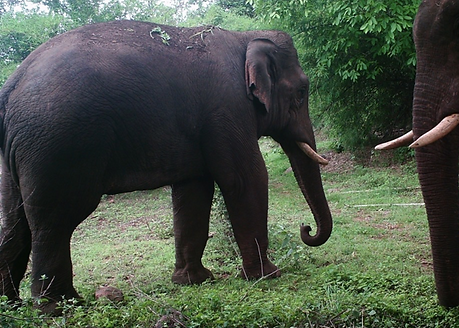
With an early interest in understanding how large mammals, such as elephants, adapt and survive in rapidly transforming, human-dominated landscapes, I have been observing elephant populations and individuals - both in the wild and in captivity - for more than fifteen years.
My doctoral research focused on the behavioural ecology of male Asian elephants in changing peri-urban environments. At present, my work seeks to improve human–elephant relationships in shared landscapes through non-human-centric design approaches that reduce negative interactions and foster coexistence between people and elephants.
Sociality
Male Asian elephants, long seen as solitary wanderers, are revealing new dimensions of sociality in human-dominated landscapes. My research over the past fifteen years has shown that as forests fragment and traditional elephant ranges transform, male elephants are not simply displaced—they adapt, forming novel all-male groups that display cooperation, learning, and even care. These associations represent more than behavioural flexibility; they are social innovations that challenge the assumption of male isolation and reflect a broader reorganisation of elephant society in response to anthropogenic change.

Reimaging Space
In fragmented landscapes, these male groups often navigate farms, forests, and towns together, co-creating what I call “rurban” spaces—hybrid ecologies where elephants and humans continually negotiate movement, memory, and belonging. This emerging sociality offers profound insight into how elephants maintain cohesion and continuity amid disruption, and how coexistence itself might be understood as an evolving, multispecies norm.
My research explores how people and elephants share and shape the spaces they inhabit together.
I study how their daily interactions influence each other’s behaviour, creating social expectations or norms that guide coexistence. This unfolds across organic spaces—what elephants and people sense through sight, sound, and smell—and imagined spaces, shaped by memory and experience.


Life-centred design
My work on life-centred design applies this approach to managing human–elephant conflict. I focus on designing systems that consider the needs, behaviours, and movements of both people and elephants. By studying how elephants navigate farms and villages, and how communities respond to them, I use design to identify shared spaces, reduce risk, and support coexistence. Life-centred design, in this context, helps shift conflict management from short-term solutions to long-term strategies that prioritise safety, empathy, and mutual adaptation.
SCIENTIFIC PUBLICATIONS
Lainé, N., Simenel, R., Labadie, M., Srinivasaiah, N. M., & Sinha, A. (2024). Human–animal interactions: Camera traps as research agents. Anthropology Today, 40, 22–26.
Srinivasaiah, N. M., & Sinha, A. (2023). The outliers: An interplay of space, knowledge, and capabilities in defining human–elephant relations in rurban southern India. In N. Láine, K. Rahmat, & P. Kiel (Eds.), Composing Worlds with Elephants: Interdisciplinary Dialogues. IRD Editions, Montpellier, France.
Srinivasaiah, N. M., Vaidyanathan, S., Sukumar, R., & Sinha, A. (2022). The rurban elephant: Behavioural ecology of Asian elephants in response to large-scale land use change in a human-dominated landscape in peri-urban southern India. In J. A. Diehl & H. Kaur (Eds.), New Forms of Urban Agriculture: An Urban Ecology Perspective (pp. 289–310). Springer Nature, Singapore.
Srinivasaiah, N. M., Vaidyanathan, S., Sukumar, R., & Sinha, A. (2021). Elephants on the move: Implications for human–elephant interactions. In R. Agarwal & O. Goyal (Eds.), The Crisis of Climate Change: Weather Report (pp. 92–103). Routledge, Abingdon, UK, and New York.
Anand, S., & Srinivasaiah, N. M. (2020). Wildlife and governance in India. In A. S. Raju (Ed.), Understanding Governance in South Asia. Routledge, London.
Srinivasaiah, N. M. (2019). Millennial males of elephant society: “Unconventional” behaviours of male Asian elephants in a human-dominated landscape of the Eastern Ghats, southern India. Hornbill, 2, 30–37.
Srinivasaiah, N. M., Kumar, V., Vaidyanathan, S., Sukumar, R., & Sinha, A. (2019). All-male groups in Asian elephants: A novel, adaptive social strategy in increasingly anthropogenic landscapes of southern India. Scientific Reports, 9, 8678.
Srinivasaiah, N. M., Anand, V., Vaidyanathan, S., & Sinha, A. (2012). Usual populations, unusual individuals: Insights into the behaviour and management of Asian elephants in fragmented landscapes. PLoS ONE, 7, e42571.
Kumar, N. S., Hedges, S., Srinivasaiah, N. M., & Karanth, K. U. (2012). Estimating density and abundance of elephants from sightings along line transects: Field methods. In S. Hedges (Ed.), Monitoring Elephants and Their Threats: A Manual for Researchers, Managers and Conservationists (pp. 151–161). Universities Press (India) Pvt. Ltd., Hyderabad.
Karanth, K. U., Kumar, N. S., & Srinivasaiah, N. M. (2012). Estimating distribution and abundance of elephant populations from sign surveys at landscape scale using occupancy modelling: Field methods. In S. Hedges (Ed.), Monitoring Elephants and Their Threats: A Manual for Researchers, Managers and Conservationists (pp. 249–258). Universities Press (India) Pvt. Ltd., Hyderabad.
OTHER PUBLICATIONS & PUBLIC ENGAGEMENT
Srinivasaiah, N. M., & Sinha, A. (2021). The elephant in the city: The trialectics of space in the rurban elephants of southern India. Urban Environments Centre, Rachel Carson Center for Society and Environment, Ludwig Maximilian University of Munich. https://urbanenv.org/elephant-in-the-city/
Srinivasaiah, N. M., & Sinha, A. (2020). The wild calling: The lives and times of the millennial elephants in the human landscapes of southern India. Presentation, Composing Worlds with Elephants – Online Academic Conference Exploring the Human–Elephant Relationship.
Sinha, A., & Srinivasaiah, N. M. (2020). The elephant in the city: Of synurbising forests and ethologising infrastructures. Presentation, Spaces of Living in Transformation – In Times of Uncertainty, Urban Environments Initiative, Rachel Carson Center for Environment and Society, LMU, Munich.
Srinivasaiah, N. M., Vaidyanathan, S., Sukumar, R., & Sinha, A. (2017). The elephant in the village: Impacts of rural transformations on the behaviour and management of the Asian elephant in southern India. Presented at the First International Conference on Contemporary Challenges to Indian State and Society, NIAS and Christ University, Bangalore.
Srinivasaiah, N. M. (2017). The apolitical elephant: Landscape-level management of the Asian elephant at the population and individual level in a human-dominated landscape. Rufford India Conference, Sawai Madhopur, Rajasthan.
Srinivasaiah, N. M. (2017). Governance of wildlife in India. International Conference on Governance in South Asia: Issues and Concerns, Pondicherry University.
Srinivasaiah, N. M., Sukumar, R., Vaidyanathan, S., Bannerghatta, M., & Sinha, A. (2016). Boy scouts in Asian elephant society. Poster, Fifth CCT–Bio Workshop on Tropical Biodiversity and Conservation, Kyoto University, Japan.
Ralph, R., Misra, A., & Srinivasaiah, N. M. (2015). Behavioural ecology and management of the Asian elephant in human-dominated landscapes of Karnataka. International Symposium on Ecology and Health Management of Asiatic Elephant, New Delhi.
Ralph, R., Misra, A., & Srinivasaiah, N. M. (2015). Conservation and management of the Asian elephant in Elephant Reserves with varying human activity levels: Perspectives and initiatives of the Karnataka Forest Department. International Symposium on Ecology and Health Management of Asiatic Elephant, New Delhi.
Srinivasaiah, N. M. (2015). Of elephants and men. Minding Animals Conference 3, Jawaharlal Nehru University, New Delhi.
Srinivasaiah, N. M. (2013). The “I” of the elephant: Assessing individual-level decision-making by the male Asian elephant. International Meeting on Biodiversity and Conservation, Indian Institute of Science, Bangalore.
Srinivasaiah, N. M. (2012). Usual populations, unusual individuals: Insights into the behaviour and management of Asian elephants in fragmented landscapes. National Conference on Perspectives in Ethology, Chennai.
Srinivasaiah, N. M. (2012). Usual populations, unusual individuals: Insights into the behaviour and management of Asian elephants in fragmented landscapes. 1st International Seminar on Biodiversity and Evolution, Kyoto, Japan.
Srinivasaiah, N. M. (2012). Elephant typecasts: Predicting individual elephant behaviour to forecast human–elephant conflict. IV International Wildlife Management Congress, Durban, South Africa.
SELECT FEATURED ARTICLES
Nishant Srinivasaiah: On First-Name Terms with Wild Elephants — RoundGlass Sustain (Profile; Aug 2018 / updated 2023)
https://roundglasssustain.com/heroes/nishant-srinivasaiah-on-first-name-terms-with-wild-elephants
Asian elephants gang up in a bid to survive an increasingly human world — Mongabay News (11 July 2019)
https://news.mongabay.com/2019/07/asian-elephants-gang-up-in-a-bid-to-survive-an-increasingly-human-world/
Elephants form unusual all-male groups to survive human landscapes — Mongabay India (11 July 2019)
https://india.mongabay.com/2019/07/elephants-form-unusual-all-male-groups-to-survive-human-landscapes/
Elephants form unusual all-male groups to survive human landscapes — The Wire Science (12 July 2019)
https://science.thewire.in/environment/elephants-all-male-groups-human-landscape-survival/
India’s elephants are changing their behaviour to cope with large-scale deforestation — Scroll.in (July 2019)
https://scroll.in/article/930162/indias-elephants-are-changing-their-behaviour-to-cope-with-the-large-scale-deforestation
To Reduce Conflicts With Humans, Get Inside an Elephant’s Head — Atlas Obscura (5 June 2023)
https://www.atlasobscura.com/articles/elephant-human-conflict-solutions-india
Water for wild elephants — Deccan Herald (Op-ed by Nishant Srinivasaiah; 28 Jan 2025)
https://www.deccanherald.com/opinion/water-for-wild-elephants-3377226
Appreciating elephant individuality: a new approach to preventing conflicts with humans — Mongabay (9 Oct 2012)
https://news.mongabay.com/2012/10/appreciating-elephant-individuality-a-new-approach-to-preventing-conflicts-with-humans/
Café Oikos: Ecology & conservation straight from the horses’ mouth (mentions Nishant Srinivasaiah) — India Bioscience
https://indiabioscience.org/columns/indian-scenario/caf%C3%A9-oikos-ecology-conservation-straight-from-the-horses-mouth
JLR Explore – Author profile and field pieces — JLR Explore
https://jlrexplore.com/authors/nishant-srinivasaiah
Scientists who work with wild Asian elephants welcome India’s climate move — Save the Elephants News
https://savetheelephants.org/news/scientists-who-work-with-wild-asian-elephants-have-welcomed-india-s-move-to-ratify-the-global-agreement-on-climate-change/
Nishant Srinivasaiah on Elephant Tracking & Conservation — YouTube (Beyonders Podcast)
https://www.youtube.com/watch?v=SyoYVoObosQ
TEDx Talk – How to Break an Elephant — YouTube (TEDx Bangalore)
https://www.youtube.com/watch?v=nCyAQy54D-Y